Aerial estimation is transforming how homeowners verify roofing contractor quotes — and it could save you thousands of dollars on your next roof replacement or insurance claim.
Replacing a roof is one of the biggest investments you’ll ever make. Yet most homeowners spend more time comparing televisions than they do reviewing roofing contractor estimates. The truth is, two contractors can inspect the same roof and return quotes that differ by thousands and the difference often comes down to accurate roof measurements, not just material or labor costs.
Before signing any contract, here’s what every homeowner needs to know.
Table of Contents
- Why Aerial Estimation Matters
- How Roofing Contractors Measure Roofs
- What a Professional Roof Measurement Report Includes
- How to Compare Roofing Contractor Estimates the Right Way
- Aerial Roof Measurements for Insurance Claims
- Red Flags to Watch for When Hiring a Contractor
- What to Do Before Signing Any Roofing Contract
Why Aerial Estimation Matters for Homeowners
Every roofing project begins with measurements and every mistake in those measurements gets multiplied across the entire estimate.
An underestimated roof leads to material shortages, project delays, and surprise costs. An overestimated roof means you pay for materials that were never needed. That’s why aerial estimation and professional roof measurement reports are essential to building a reliable, accurate roofing quote.
When contractors use aerial roof measurement technology, measurements are calculated from high-resolution satellite imagery rather than manual visual estimates alone — delivering a higher level of consistency and accuracy.
Quick Fact: Studies show roofing estimate discrepancies of 10–20% are common when contractors rely solely on manual measurements.
How Roofing Contractors Measure Roofs
Not all contractors follow the same measurement process and that gap directly affects your roofing contractor estimate.
Manual Measurements: Some contractors physically measure the roof during an inspection. This can be accurate but is prone to human error, especially on complex roof designs.
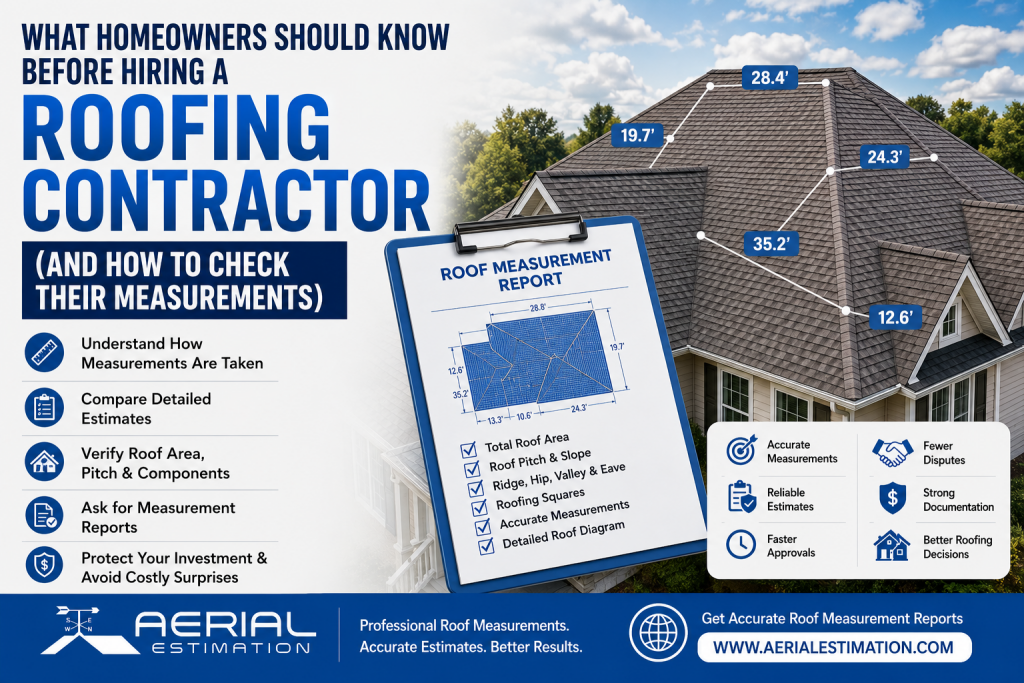
Aerial Estimation Technology: The most reliable contractors use professional aerial roof measurement reports generated from satellite and drone imagery. These reports include:
- Total roof area calculations
- Ridge, hip, valley, and eave lengths
- Accurate pitch and slope data
- Roof takeoff reports for material planning
- Professional roof sketch reports with visual diagrams
Always ask your contractor: “How did you measure my roof, and can you provide documentation?”
What a Professional Roof Measurement Report Includes
A quality roof measurement report goes well beyond just total square footage. A complete aerial estimation report typically includes:
| Data Point | Why It Matters |
|---|---|
| Total Roof Area | Determines material quantities |
| Roof Pitch & Slope | Affects labor cost and complexity |
| Ridge & Hip Lengths | Impacts cap shingle quantities |
| Valley Lengths | Affects flashing and underlayment |
| Roof Takeoff Report | Full material list for accurate bidding |
| Roof Sketch Report | Visual layout for scope verification |
When your contractor’s roofing contractor estimate is backed by this level of detail, you can compare quotes with confidence knowing all estimates are working from the same verified data.
How to Compare Roofing Contractor Estimates the Right Way
Never choose a contractor based on price alone. A lower roof replacement estimate doesn’t always mean better value — it often means something important was left out.
Key items to verify in every estimate:
- Drip edge and starter shingles
- Underlayment type and coverage
- Ridge cap shingles and ventilation
- Flashing around chimneys and skylights
- Cleanup and haul-away costs
- Manufacturer warranty details
A detailed roof inspection report and professional aerial estimation data help you compare what’s actually included not just the bottom-line number. For additional guidance on evaluating contractor quotes.
Aerial Roof Measurements for Insurance Claims
For storm-damaged roofs, accurate roof measurements become even more critical.
Insurance adjusters review roof dimensions, material quantities, waste calculations, and project scope before approving any payout. If your contractor’s estimate contains inaccurate measurements, it can create disputes, delays, or reduced payouts on your roofing insurance estimate.
A professional aerial roof measurement report supports your claim by providing:
- Verified roof dimensions adjusters can trust
- Accurate roof takeoff report data for material quantities
- A detailed roof sketch report for visual scope verification
- Documentation that aligns your contractor’s quote with insurer expectations
Submitting a claim backed by professional aerial estimation data gives you a much stronger foundation for a faster, smoother approval.
Red Flags to Watch for When Hiring a Contractor
While most roofing contractors operate with integrity, there are warning signs every homeowner should recognize before committing to a roof replacement estimate.
Proceed with caution if a contractor:
- Cannot explain how measurements were calculated
- Refuses to provide a roof measurement report or supporting documentation
- Offers a price without physically inspecting or measuring the property
- Provides a quote significantly lower than all other estimates
- Avoids discussing materials, warranties, or project scope in detail
Reputable contractors are transparent about their aerial estimation process and happy to walk you through their roof inspection report and measurement data.
What to Do Before Signing Any Roofing Contract
Follow these steps to protect your investment:
- Request a professional roof measurement report — before accepting any estimate
- Ask how measurements were obtained — manual or aerial estimation technology
- Compare full scope, not just price — verify all line items are included
- Check credentials — license, insurance, and manufacturer certifications
- Get everything in writing — materials, timeline, warranty, and payment terms
Starting with verified aerial roof measurement data puts you in control of the entire process — from the first estimate to the final nail.
The Bottom Line
Hiring a roofing contractor isn’t just about finding the lowest price. It’s about making sure your roofing contractor estimate is based on accurate roof measurements, a complete scope of work, and transparent documentation you can trust.
The best contractors rely on professional aerial estimation, detailed roof sketch reports, accurate roof takeoff reports, and verified roof measurement reports to deliver estimates that hold up — whether for a standard replacement or a complex roofing insurance estimate.
Visit aerialestimation.com to get precise roof measurement reports that help contractors build accurate estimates and help homeowners make better roofing decisions.