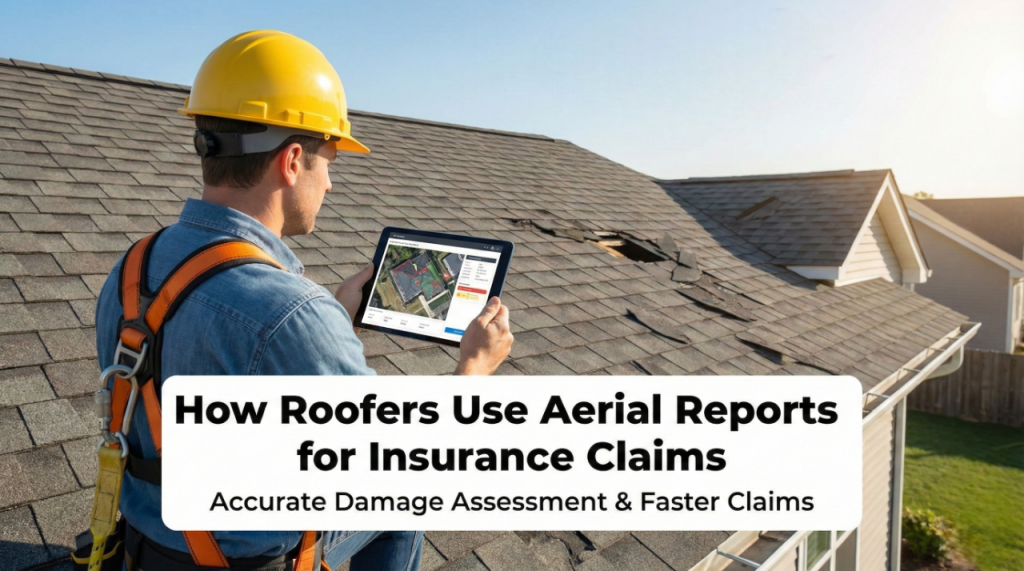
Roofers have increasingly turning to aerial reports for insurance claims after an event that causes damage through storms in their business streams. The emergence of advanced measurement and imagery technologies allows roofing contractors to produce accurate, rapid, and legally defendable documentation that satisfies the requirements of insurance carriers. This complete guide describes how professional roofing teams utilize aerial data to expedite the claim process, avoid disputes, and maximize homeowners’ payments.
Table of Contents
Why Aerial Reports Matter in Modern Roofing Insurance Claims
Precision and proper documentation are critical elements within the roofing industry. Insurance adjusters want accurate dimensions, verified photo documentation and a documented record of how a roof was damaged during a storm or other catastrophic event. Although some roofers have historically, this is where aerial reports for insurance claims outperform manual inspection methods by providing:
- High-quality aerial photographs
- Accurate dimensions of roofs (with pitch/slope & surface area)
- Evidence of hail damage and wind damage
- Quick turn-around times
- Third-party verified data
Roofers using these types of data can submit stronger claims for insurance, eliminating delays and possibly reducing the number of rejected claims due to lack of documentation or adequate documentation support.
Aerial Reports Provide Accurate Roof Measurements for Faster Claim Approvals
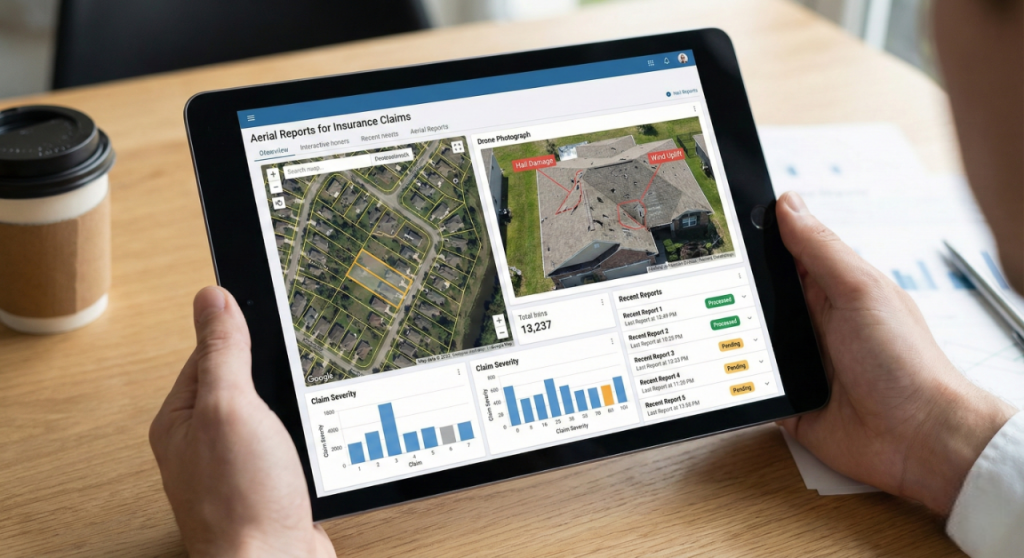
Roofing insurance claim measurement accuracy is one of the most significant challenges faced by contractors. Manual roof measurement methods can often yield unreliable results due to changing conditions when working on very steep or complex roof designs. The advantages of using aerial reports for insurance claims processing include providing the roofing contractor with:
- Total Roof Area
- Pitch/Slope Calculations
- Facet Breakdown
- Ridge/Hip/Valley/Rake/Eave Measurements
- Linear Footage Details
- Recommended Waste Factor
The precision of aerial report information eliminates confusion and disagreement between the roofing contractor and insurance carriers regarding the roof size, materials needed, and the overall scope of work, thus resulting in quicker processing of aerial reports for insurance claims.
High-Resolution Imagery Helps Identify Hail & Wind Damage Clearly
Insurance companies frequently challenge claims for storm damage, claiming inadequate proof exists to support such claims. However, aerial technology solves these problems with incontrovertible visual evidence. Professional aerial reports for insurance claims include:
- Orthographic images
- Oblique photographs
- AI-enhanced verified damage
- Weather footprints on site
- Hail size verification from the storm’s data
- Wind speeds and wind direction analytics
All of these examples provide very clear visual evidence regarding where damage exists and what the level of damage is, thus proving to roofers that they can properly substantiate repair or complete replacement of roofs and greatly reducing the possibility of a claim being denied.
Aerial Reports Reduce On-Site Risks and Inspection Time
Evaluating roofs following storm damage through climbing to evaluate them is both dangerous and inefficient. Roofers are now evaluating roofs using satellite technology. More specifically, by using aerial reports for insurance claims, roofing teams can:
- Avoid climbing roofs to evaluate condition
- Complete evaluations during extreme weather events faster than ever before;
- File multiple claims in one day
- Reduce the cost of labour and time spent evaluating roofs
- Improve Compliance with applicable safety requirements.
In addition, insurance adjusters will benefit from having consistent, third-party verified documentation to make their evaluation process much faster and less of a hassle for all parties involved.
Aerial Reports Help Roofers Create Accurate Estimates for Insurance Claims
In order to provide precise insurance estimates, it is important to have accurate material lists and cost breakdowns. The use of aerial reports for insurance claims enables roofing contractors to:
- Create Accurate estimates using Xactimate for insurance claims
- Calculate waste and materials correctly
- Verify the square footage for all types of roofing including shingles, metal, tile, or flat roofs
- Calculate labor costs based on both the steepness and complexity of the roof.
Since aerial measurements are much more accurate than manual measurements, most insurance companies do not dispute the quantities of materials and the methods used to justify their costs.
Improving Communication With Insurance Adjusters
Aerial Reports are a neutral, third-party data source that helps improve communication between roofers and insurance adjusters by reducing the potential for miscommunication and also providing contractors with a way to demonstrate:
- The severity of damages
- The accuracy of measurements
- The amount of work necessary to repair/replace the roof
- Whether the contractor is in compliance with the local building codes
- Consistency of documentation
The use of aerial reports for insurance claims may make discussions of insurance claims more efficient, enable insurance companies to process claims faster, and ultimately help homeowners receive fair compensation more consistently.
Aerial Reports Increase Homeowner Trust and Close More Jobs
Homeowners trust roofing contractors that have technology and provide an advanced level of service. Aerial Reports and Professionalism are shown when roofers provide the homeowner with aerial reports for insurance claims. This technology option for homeowners provides;
- Before/After Roof Scans
- Quality Pictures of Damage
- Quick Turnaround on Claims
- Clear Scope of Work
- Decrease in the Risk of Inspections
Roofing contractors who take advantage of this type of technology will continue to have an increased number of closed deals and develop a reputation for long-term credibility.
How Roofers Submit Aerial Reports in Their Insurance Claim Packages
The speed with which claims can be approved is increased by submitting a complete claim file.
Roofs typically include:
- An Aerial Roof Measurement Report
- Photographs of damaged property along with annotations
- Storm event data including date/time/location of hail or wind storms
- Xactimate Estimates or independently prepared Estimates
- Supporting notes providing general support to the claim and recommendations
Having this complete set of documents available to an aerial reports for insurance claims carrier allows them to properly and efficiently process the claim.
Why Insurance Carriers Prefer Aerial-Based Documentation
Due to the following factors, insurance carriers increasingly utilize aerial imagery:
- Consistency
- Objectivity
- Third-party verification
- Quick turnaround time
- Decreased errors
- Visible damage
Submission of aerial assessments from roofers with aerial reports for insurance claims allows for greater ease of processing and fewer disputes because insurance carriers can validate the available information with the data in their respective systems.
The Competitive Advantage for Roofers Using Aerial Reports
Companies that utilize aerial technology gain tangible benefits from their competitors’ use of this innovation, including:
- Quicker Turnaround on Projects
- Improved Claim Approval Rate
- Shortened Time Needed for Inspections
- More Precise Estimates
- Increased Customer Confidence
- Increased Efficiency and Streamlined Processes
Members of the construction industry who provide aerial reports for insurance claims are viewed by potential customers as more competent, productive, and dependable and hence attract additional customers during the times of year when storm activity is most prevalent.
Conclusion: Aerial Reports Are the Future of Roofing Insurance Claims
Roofing contractors work in a very competitive field and therefore require as many advantages as possible. Aerial reports for insurance claims offer unequaled accuracy, confirmation of evidence and fast approval. This allows a roofing contractor to provide their customers with high quality work and to assist them in maximizing their insurance payouts. The use of a photo system also gives the Roofing Contractor an advantage over manual inspections in terms of efficiency. As more and more insurance companies begin to adopt aerial mapping technology, roofing contractors using aerial mapping technology can be more successful in closing claims and keeping customers happy, resulting in a long-term trust relationship between the roofing contractor and their customer.
FAQs
1. What do insurance companies use aerial imagery reports to do?
Aerial reports assist in providing accurate estimates and identifying the extent of roof damage caused by a storm using images and measurements taken by satellite.
2. Why are aerial reports used by roofers when filing insurance claims?
Roofers utilize aerial reports as a means of providing end-users with accurate size and pitch measurements, as well as clear documentation of storm damage. They also reduce the time it takes for the insurance company to process a claim.
3. Do aerial reports reduce disputes regarding insurance claims?
Yes, due to the fact that aerial reports are based on third-party verified data and images, they help reduce the possibility of disputes between insurance adjusters and the insured.
4. Are storm damage due to hail or wind identifiable with aerial reports?
Yes, using high-resolution imagery and storm-tracking data, aerial reports enable verification of the impact of hail on roofs and the related damage due to wind.
5. What is the turnaround time for the availability of aerial reports for insurance claims?
On average, most companies can create and provide an aerial report for insurance claims in a matter of hours, which allows the roofer to start processing the claim or estimating as soon as possible.