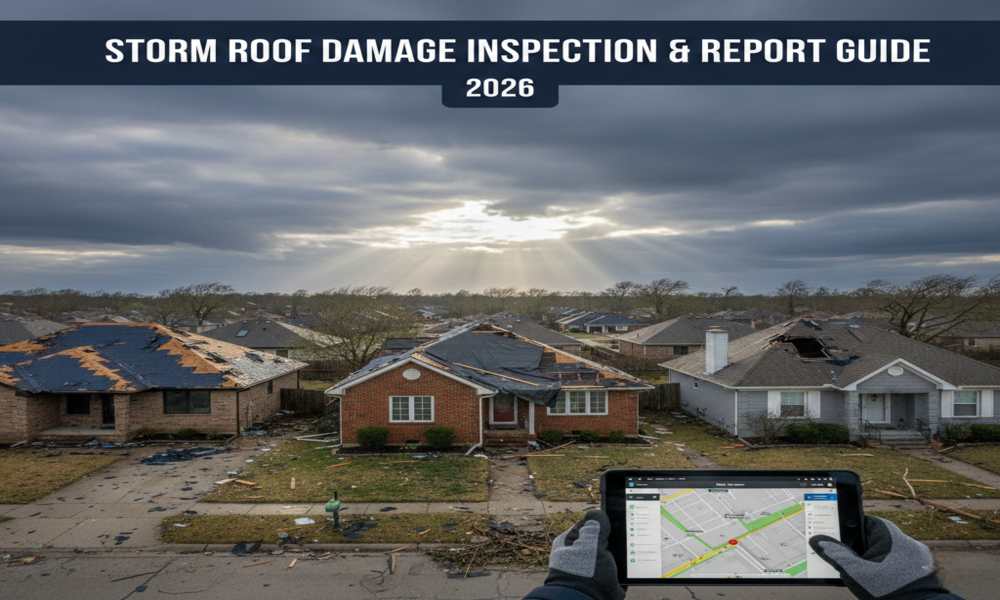
In 2026, one of the biggest dangers that a residence or business faces is damage from storms to the roof. There has been an increase in severe weather occurring across North America, and therefore roof inspections, detailed reports of storm roof damage and precise aerial measurements must be supplied to assist contractors and property owners in obtaining insurance approval for quicker restoration of their properties.
AerialEstimation.com has developed a high-precision storm damage assessment service and a professional report format to satisfy the needs of contractors, insurance adjusters, and property managers who require speed, accuracy, and conformity. This guide will explain how to identify and document, resulting in much quicker claims processing and a greater chance of approval.
Table of Contents
Understanding Storm Roof Damage in 2026
Roof damage due to storms usually occurs as a result of:
- Hail damage due to impact
- Uplift of shingles by the wind
- Heavy rain leaks through roof system
- Hurricane strength destruction to the roof structure.
- Debris falling or trees coming down on the roof
- Ice dam formation causes water to back up.
Every type of storm has a different way of damaging the roof. Identifying these damage patterns quickly can help to document your claim accurately and avoid expensive damage to the structure.
Types of Storm Roof Damage Contractors Must Identify
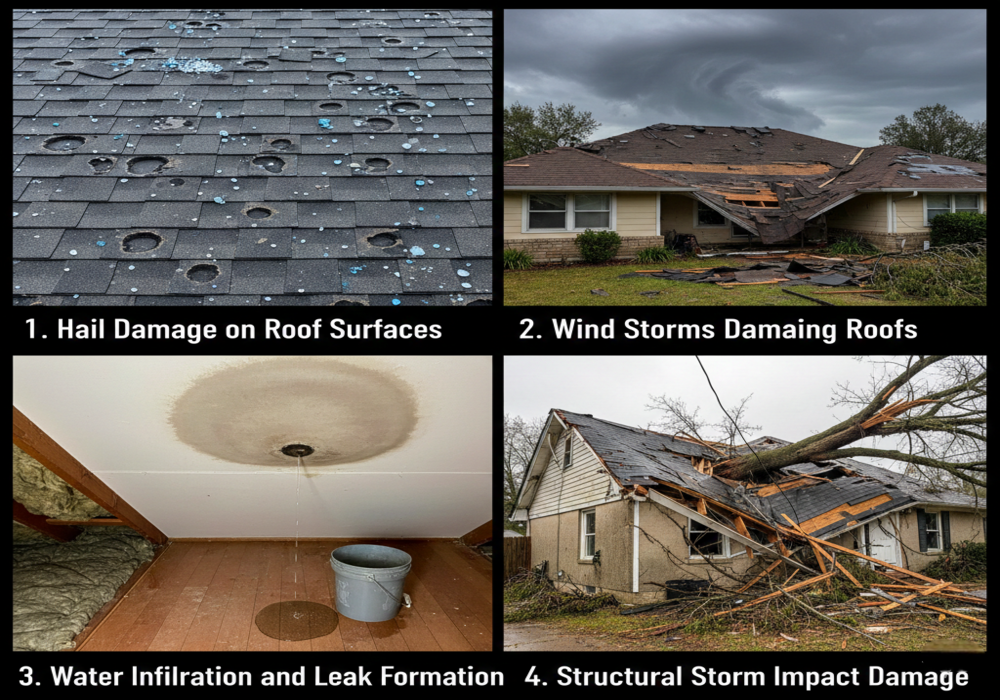
1. Hail Damage on Roof Surfaces
Hail strikes create:
- Granule loss from asphalt shingles
- Circular bruises on roofs
- Fractured shingle mats
- Dents in soft metal vent pipes or flashings
- Cracked tile roofs
Aerial inspections conducted with high resolution enable us to find micro-fractures that cannot be seen by looking at the ground below.
2. Wind Storms Damaging Roofs
Damage occurs from wind-driven storms by:
- Lifting shingles
- Removing ridge caps
- Bending tabs on asphalt shingles
- Removing flashing from roof
- Tearing the underlayment
If wind damage is not documented as soon as it occurs, it can lead to progressive intrusion of water through the roof.
3. Water Infiltration and Leak Formation
Intense storms can cause the following areas to be subject to water invasion:
- Decking systems
- Attic insulation
- Structural components (beams)
- Interior ceiling
The identification of compromised areas can be accomplished using a combination of moisture of mapping and aerial roof measurements.
4. Structural Storm Impact damage
Extreme weather can produce destructive forces.
- Sagging roofs
- Gapped Decks
- Damaged Framing Members
- Chimneys coming away from the frame
- The failure of the gutter system
A full comprehensive storm damage inspection will ensure that all of the structural deficiencies are identified and included in the storm damage inspection report.
Storm Roof Damage Inspection Process
Step 1: Remote Aerial Measuring Technology
By using the latest technology in aerial measurement software, we will obtain:
- Total Square Footage of Roof
- Pitch and slope measurements
- Measurements for Ridges/Valleys/Hips
- Waste factor estimation
This allows for quicker inspection times and no human error in measurement.
Step 2: High-Resolution Image Analysis
Satellite imagery identify:
- Impact zones
- Missing shingle patterns
- Water pooling
- Flashing damage
Every damage point is mapped precisely for reporting accuracy.
Step 3: Damage Annotation & Marking
All storm-related damage areas are:
- Labeled
- Categorized
- Quantified
- Supported with visual documentation
Clear annotation improves claim approval rates significantly.
Step 4: Insurance-Ready Storm Damage Report Creation
Your comprehensive report will include:
- Property Overview
- Date of Storm
- In-Depth Summary of All Measurements
- How Damage is Classified
- Repair Breakdown
- Amount of Items to Replaced
All Documentation Use By Insurance Carriers (2022).
Why Accurate Storm Roof Damage Reports Increase Claim Approvals
The requirements for insurance providers are:
- Verified Measurements
- Clear Photodocumentation
- Type of Damage Identified
- Line Item Breakdown
Inaccurate Reports Create:
- Claim Delays
- Underpayments
- Re-inspections
- Disputes
Our Inspection Reports Provide Removal of Ambiguity with Accurate Data that Insurance Companies Use.
Advanced Tools Used in Inspections
Some ways advanced inspection technology can be used are:
- Artificial Intelligence – Aerial Analysis
- Satellite – Roof Image Viewing
- Digital – Pitch Measurement System of Roofs
- Storm Impact Mapping Software
The result of the above technology includes:
- Quick turn-around time on inspections
- Less risk on site
- More Accurate Reporting
- Higher Efficiency by Contractors
Common Signs of Homeowners Miss
The following are some of the overlooked problems that cause roofs to deteriorate:
- Displaced granules (very subtle).
- Creasing of shingles (often difficult to notice).
- Flashing loosened (to some extent).
- Cracked vent collars (very minor).
- Debris causing small punctures.
These problems, if undetected, will, over time, lead to:
- Mold growth.
- Weakened structure.
- Water damage inside buildings.
- Higher repair costs.
If an inspection is performed on an early basis, many of these repairs will not need to be extensive.
Storm Roof Damage and Insurance Claim Timeline
Reliability of the timeline is critical to the process:
- Storm event occurs
- Roof inspection promptly scheduled
- Damage was documented 24 hours after the storm occurred
- Insurance claims are submitted
- Adjuster verifies the damage
- Repair approval issued
Both speed & accuracy are important in the competitive restoration industry.
Roof Measurement Accuracy Matters in Storm Claims
Estimating the square footage incorrectly causes:
- Shortage of materials
- Underpayment of claims
- Exceeding the budget
- Measuring accurately will ensure:
- You will order the materials accurately
- Your labour will be calculated correctly
- You’ll receive the maximum insurance payment
Using aerial measuring technology nearly eliminates any chance of error.
Storm Roof Damage in Residential vs Commercial Properties
Residential Roofs Can Be Constructed With:
- Asphalt Shingles
- Metal Roofing Panels
- Tiled Roof Systems
- Composite Roofing
Damage Occurs Typically On Individual Slopes And At The Ridge Of The Roof.
Commercial Roofs May Be Constructed With:
- TPO Roofing Membranes
- EPDM Roof Systems
- Modified Bitumen
- Flat Roof Drainage Systems
Storm Damage May Be Evident On The Seams, Penetrations Or On The Adherence Of Any Membrane.
Preventative Strategies After Storm Roof Damage
Property owners should:
- Schedule immediate inspection
- Avoid temporary DIY repairs
- Document visible damage
- Check attic moisture levels
- Maintain gutters and drainage
Preventative action reduces long-term repair costs.
Benefits of Professional Inspection Services
When selecting professional inspection services, you can expect:
- A speedy report turnaround
- Documentation compliant with insurance requirements
- Aerial imaging that shows detail
- Accurate measurement for roofs
- Improved closing ratios with contractors
In today’s competitive storm restoration markets, the ability to be rapid and accurate are key in securing contracts.
How AerialEstimation.com Supports Contractors in 2026
We provide:
- 6-hour storm report turnaround time
- Damage maps with complete documentation
- Documentation ready for insurance claims
- Accurate roof take-off calculations
- Digital PDF report delivery
Our systems provide contractors with the following capabilities:
- Submitting claims quicker
- Closing jobs faster
- Increasing approval rates
- Decreasing the risk of reinspections
Storm Roof Damage Inspection Checklist
Check that all of these elements are complete/recorded before filing your insurance claim:
- Roof Measurement – complete measurement of your roof.
- Determine the slope of the roof accurately.
- Take photos showing each area of damage.
- Date of Storm/Event.
- Document the type of materials used on your roof.
- Scope of the proposed repairs/replacement.
- Total Square of the Roof.
- Line Item Cost Breakdown.
Future of Storm Roof Damage Reporting in 2026 and Beyond
Emerging technologies are transforming inspections:
- AI damage recognition
- Automated claim integration
- Predictive storm impact modeling
- Real-time satellite updates
Contractors leveraging these innovations gain a major competitive advantage.
Final Thoughts on Storm Roof Damage Inspection & Reporting
No longer considered “optional,” accurate, detailed, and professional inspections of the damaged roofs due to storm-related weather events are now critical for:
- Success with insurance companies
- Fast turnaround time for projects
- Greater profits
- Less chance of being held liable due to negligence
As of 2026, contracting companies that utilize precise aerial measurements, advanced imagery, and structured reports will lead the competition in getting business through restoration after storms have occurred. Professional storm roof inspections provide contractors with reliable, insurance-ready documentation that gives them quantifiable results.
FAQs
1. What is storm roof damage?
It occurs when hailstones, high winds, excessive rain, hurricanes, or flying objects cause structural failure or surface destruction to the roof.
2. How do I know if I have storm roof damage?
The most frequent indicators that you may have sustained storm roof damage are missing shingles, dented vents, loss of granules, roof leaks, water stains, and loose flashing.
3. Does insurance cover storm roof damage?
Most homeowners insurance policies will pay for storm roof damage due to hail, wind, and falling debris if the damage is properly documented and reported.
4. How soon should I inspect my roof after a storm?
You should have your roof inspected by a professional as soon as possible, ideally within 24 hours after the storm, so that you can begin the claim process for your insurance company.
5. Can minor storm roof damage become serious later?
Even a small amount of damage to your roof, if left uncorrected, may present the potential for serious damage.