Roof measurements are one of the most trusted inputs in an estimate, and also one of the least questioned, which is exactly why they’re where the costliest errors hide.
Most contractors treat a roof measurement report the way they treat a delivery receipt: it shows up, the number looks about right, and it goes straight into the estimate. That habit works fine ninety percent of the time. The other ten percent is where change orders come from, where an adjuster kicks a claim back for revisions, and where a homeowner ends up staring at an invoice that doesn’t match what they were quoted.
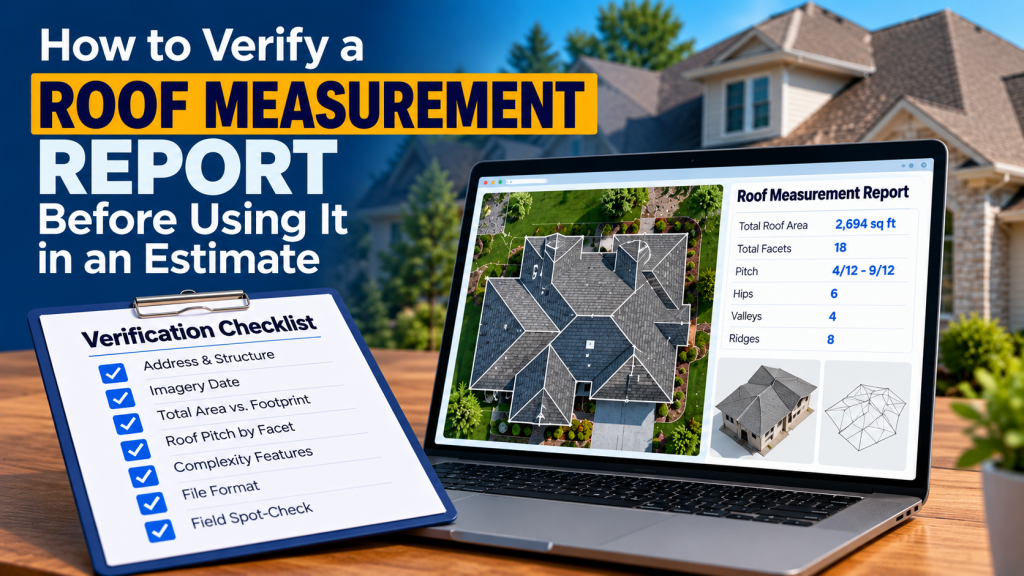
Here’s the seven-point check contractors and adjusters use to verify a report before it becomes the basis of an estimate.
What Verification Actually Means
A measurement report, whether it came from a satellite pass, a drone flight, or a technician tracing rooflines off high-resolution imagery, is a data product.
Like any data product, it can be built on an old image, matched to the wrong parcel, or rounded in a way that quietly understates complexity. None of that shows up unless someone actually looks. Verification isn’t about distrusting the provider, it’s about catching the handful of errors that are common enough to plan for, before they turn into a callback.
The reality: The reports that cause problems are almost never wildly off. They’re off by a hip that got counted as a ridge, or a facet that was measured a season before a dormer got added. A five-minute check against a verified roof measurement report catches this before it reaches the estimate.
The Seven-Point Check
A real check has one job: confirm the report describes this roof, as it looks right now, in enough detail that every material and labor line traces back to accurate roof measurements instead of an assumption. That’s a five-minute process, not a re-measurement.
| Check | What to Look For |
|---|---|
| Address & structure | Confirms the report matches the building you were asked to quote, not a neighbor’s roof or outbuilding |
| Imagery date | Flags whether the roof’s geometry has changed since capture (addition, re-roof, storm damage) |
| Total area vs. footprint | A rough sanity check that the roof-to-footprint ratio matches the roof style |
| Roof pitch by facet | Confirms steep-assist and safety pricing is based on real per-section slope, not a blended average |
| Complexity features | Hand-count hips, valleys, and dormers against the diagram to confirm the waste-factor basis |
| File format | Confirms the export opens cleanly in your estimating software with facets and pitches intact |
| One field spot-check | One hand-measured eave or ridge line compared to the report confirms the rest is reliable |
Why Roof Pitch Deserves Its Own Check
A blended, whole-roof pitch is close to useless for pricing steep-assist or safety requirements accurately.
A section listed at a modest 4/12 roof pitch prices very differently than a steep 9/12 or 12/12 section a few feet away. Confirm the report breaks pitch out facet by facet, especially on roofs with mixed rooflines, dormers, or additions where one section is noticeably steeper than the rest.
The reality: Roof pitch is one of the easiest fields to verify without special equipment. Measure the rise and run of a section by eye or with a level, plug those two numbers into a roof pitch calculator, and compare the result to what the report lists. A roof at a 4/12 roof pitch rises 4 inches for every 12 inches of horizontal run, a modest slope that calls for different safety gear and pricing than a steep 9/12 or 12/12 section. Running one facet through a roof pitch calculator takes under a minute and catches the kind of rounding error that can throw off a steep-assist charge before it ever reaches the estimate.
Red Flags That Mean Send It Back
Most reports pass the check above without issue. When something doesn’t line up, these are the situations that warrant a revision request rather than a judgment call.
| Signal | Why It Matters |
|---|---|
| Imagery older than any known roof work | The report may be measuring a roofline that no longer matches the physical building |
| Facet count doesn’t match a visible dormer or addition | Usually means the imagery predates a structural change, or the tracing missed a section |
| Pitch listed as a single blended number on a complex roof | Makes steep-assist and material pricing unreliable on anything but a simple gable or hip |
| Waste factor or valley count noticeably low for visible complexity | A frequent source of under-ordering material and underestimating labor hours |
| Export file won’t open cleanly in your estimating software | Forces manual re-entry, reintroducing the exact human error the report was meant to eliminate |
Why This Step Matters More in 2026 Than It Used To
Roof measurement reports have gotten dramatically faster to produce. Same-day and even instant turnaround is now standard, and AI-assisted tracing has cut the time between an order and a finished report from days to minutes in a lot of cases.
That speed is a real win for contractors and adjusters who used to wait on manual measurements. But it also means the bottleneck in the process has moved. It used to be measurement speed. Now it’s trust in the output.
The reality: Insurance teams have felt this shift first. Adjusters increasingly treat a documented verification step, not just the report itself, as part of what makes a claim file defensible. Contractors are catching on for the same reason: a fast report that’s wrong costs more time than a slower one that’s right, once you count the change order, the reorder, and the conversation with a homeowner who was quoted the wrong number.
None of this means treating every report with suspicion. It means building a five-minute habit around the reports you already trust, so the rare bad one gets caught before it becomes an expensive one.
Want a Report That Passes Every Check on the First Read?
A verification habit is only as good as the report you’re checking. Aerial Estimation delivers measured, facet-by-facet roof measurement reports with per-facet roof pitch, complexity counts, and file formats your estimating software already expects, built to drop straight into your estimate.
Visit aerialestimation.com/pricing to order a report today.