
Two words. Almost every roofer uses them interchangeably without a second thought. And most of the time, that’s fine, until the moment it isn’t, and a quiet mix-up between the two ends up costing real money on a job that looked perfectly normal on paper.
Ask ten roofing contractors what the pitch of a roof is, and most of them will describe slope. Ask them to explain the difference between the two terms, and the room usually goes quiet. That’s not a knock on the trade, it’s just how the language evolved. Roof pitch and roof slope describe closely related ideas, get used in the same breath on every job site in the country, and have quietly merged into one word in everyday conversation. The problem is that they’re calculated differently, and on certain jobs, that difference is exactly where an estimate starts to fall apart.
This isn’t an academic distinction. It’s the kind of thing that shows up months later as a frustrated phone call from a job site that needed more shingles than were delivered, or as a claim that an insurance adjuster sends back with a note questioning the labor rate. Small vocabulary confusion at the start of a project has a way of becoming a very real cost by the end of it.
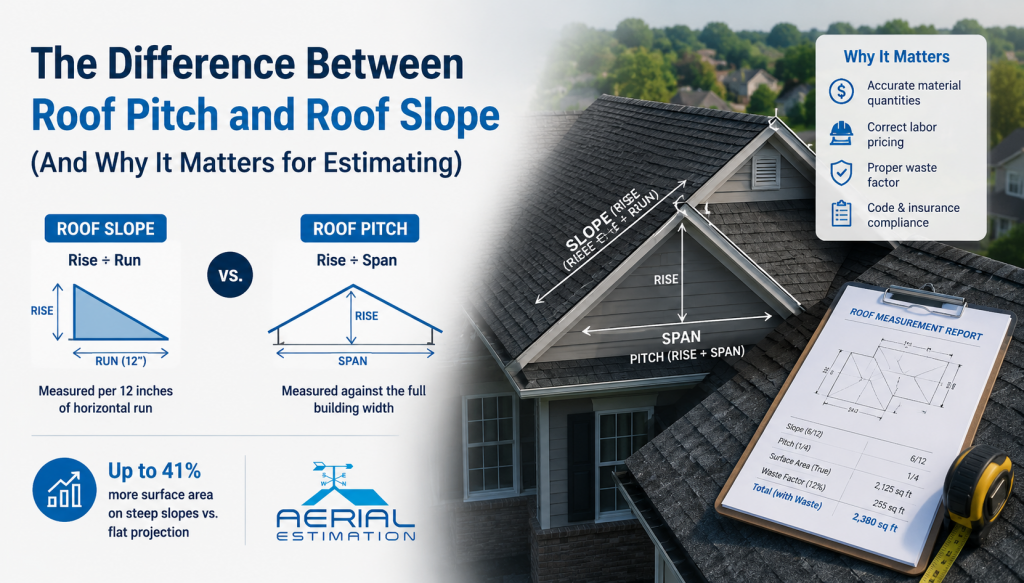
| Rise ÷ Run Roof slope: measured per 12 inches of horizontal run | Rise ÷ Span Roof pitch: measured against the full building width | Up to 41% more surface area on steep slopes vs. flat projection |
Two Numbers, Two Reference Points, One Roof
Roof slope describes the angle of a roof surface as a ratio of vertical rise to horizontal run, measured over every 12 inches of horizontal distance. A roof that climbs 4 inches for every 12 inches it runs horizontally is a 4/12 slope. One that climbs 8 inches over the same 12-inch run is an 8/12 slope. This is the number most people picture when they hear the word pitch shouted across a job site, and it’s used constantly: to confirm a shingle is rated for the application, to calculate true surface area from a flat projection, to set steep-slope labor rates, and to determine whether code requires ice and water shield underneath.
Roof pitch, in its formal sense, measures something slightly different. It expresses the relationship between vertical rise and the full span of the building, outside wall to outside wall, not half of it. The formula is rise divided by span. A building 24 feet wide with a roof peak sitting 6 feet above the top plate has a pitch of 6/24, which simplifies to 1/4. Slope and pitch are describing the same physical roof, just from two different reference points, one using half the building’s width, the other using the whole thing.
In day-to-day conversation, almost nobody draws this distinction. When a roofer says “pitch,” they virtually always mean slope, and the industry has long since accepted that overlap as normal. The formal difference only really resurfaces when you’re reading architectural drawings, working through structural calculations, or filling out certain insurance documentation where the precise term actually matters.
Why This Number Quietly Runs the Entire Estimate
Whichever definition you’re using, the underlying angle of the roof surface has an outsized effect on what an estimate actually costs to fulfill. It touches material quantities, labor pricing, waste percentages, and even which products can legally go on the roof at all.
Start with surface area, because this is where the math gets easy to underestimate. A roof that looks like it covers 1,500 square feet of horizontal floor space actually covers considerably more physical surface once the slope is factored in, and the steeper that slope, the bigger the gap becomes. Estimators account for this using a pitch multiplier, a factor that converts a flat, projected area into the true surface area that needs to be covered in material.
| Slope | Multiplier | Slope | Multiplier |
| 4/12 | 1.054 | 10/12 | 1.302 |
| 6/12 | 1.118 | 12/12 | 1.414 |
| 8/12 | 1.202 |
An estimate that skips this multiplier, or applies the wrong one because the slope was guessed rather than measured, will under-order materials. On a low-slope roof, that shortfall might be minor. On a steep roof, it can leave a crew short by a meaningful percentage of the material they need, discovered halfway through a job that’s already underway.
Labor pricing follows the same pattern. Steep slope roofing, generally anything above 6/12 or 7/12, demands more safety equipment, slower and more careful movement, and noticeably more physical effort per square installed. Insurance adjusters know this, and they scrutinize labor rates specifically in the context of the slope documented in the claim. If the slope data on file doesn’t match what the adjuster independently calculates, the labor pricing built on top of it won’t line up either, and that mismatch is exactly the kind of detail that triggers a second look, a delay, or a reduced payout.
Waste factor tells a similar story. Steeper roofs generate more scrap, because the angles at hips and valleys demand more cuts and more discarded material. A simple, low-slope roof might reasonably run a 10 percent waste allowance. A steep, complex roof full of hips and valleys might justify 18 to 22 percent, and that number needs to be defensible, not just convenient. Accurate slope data is what makes a waste percentage like that something an adjuster can approve without pushing back, rather than something that gets flagged as inflated.
Material selection sits on top of all of this. Not every roofing product is rated for every slope. Asphalt shingles, standing seam metal, modified bitumen, and dedicated low-slope systems each carry their own minimum slope requirements, and getting that number wrong at the estimating stage risks specifying a product that shouldn’t legally go on that particular roof in the first place.
The Problem Gets Bigger on Roofs With More Than One Plane
Almost no residential roof has a single, uniform slope. Most have several distinct planes, each one facing a different direction and often pitched at a different angle than its neighbor. A main roof might sit at 6/12 while a dormer above it runs steeper, and an attached porch roof below sits noticeably flatter than both.
Averaging all of that into one slope number for the whole structure feels efficient, but it introduces error at every single stage that follows, surface area, material quantity, waste factor, and labor pricing all inherit whatever inaccuracy got baked into that average. This is precisely why plane-by-plane pitch data, the kind generated by a professional aerial roof measurement report, carries so much more value than a single estimated slope applied across an entire roof. Each section gets its own verified number, which means each section gets priced and ordered for what it actually is, not for what the roof looks like from the ground on average.
Why Getting This Right Protects the Whole Estimate
None of this requires abandoning the way the trade talks. Calling it pitch when you mean slope isn’t the problem, the entire industry does it, and that’s unlikely to change. The problem only appears when the underlying number itself, whatever you call it, was guessed instead of measured.
A verified, plane-by-plane slope reading turns every downstream calculation, material quantities, waste percentage, labor pricing, and code compliance, into something built on solid ground instead of a visual estimate from the driveway. That’s the difference between an estimate that survives contact with an adjuster’s review and one that comes back with questions attached.
| Get Verified, Plane-by-Plane Slope Data on Every Roof Aerial Estimation provides professional roof measurement reports with verified, plane-by-plane slope data that feeds accurate estimates and supports insurance claims, delivered fast, with no one needing to climb the roof. → www.aerialestimation.com |