You did the inspection. Wrote up the estimate. Submitted the claim.
And then the adjuster came back with a lower number, or worse, kicked it back entirely.
Sound familiar? You’re not alone. Most roofing contractors assume the fight is about the damage. It’s not. It’s almost always about the paperwork.
Here’s what’s actually getting your roofing insurance estimates rejected and how to stop it.
Wrong Measurements Kill Claims Before They Start
If your square footage doesn’t match what the adjuster pulls from aerial data, your entire estimate loses credibility even the parts that are right.
Insurance companies cross-reference your numbers. When they don’t line up, the conversation shifts from “how much damage?” to “can we trust this contractor?” That’s a fight you don’t want to be in.
Accurate, third-party aerial roof measurements eliminate that argument completely. Tools like EagleView or GAF QuickMeasure produce GPS-verified data adjusters can’t dispute. When your numbers match theirs, approvals move faster.
Missing Line Items Are Quietly Draining Your Payouts
Drip edge. Starter shingles. Ice and water shield. Ridge cap. Pipe boots. Haul-away fees. Permit costs.
These aren’t extras they’re standard scope items. But they get left off estimates constantly, and every missing line item is a reason for the adjuster to cut your payout or send it back for revision.
A complete roofing insurance claim scope isn’t just about what you saw on the roof. It’s about documenting every code-required component so there’s no room to reduce.
Bad Waste Calculations Are a Red Flag
A flat 10% waste factor on every job is a quick way to get flagged. A complex hip roof with multiple valleys and penetrations might legitimately need 18–20% — but only if you can show why.
Waste is driven by pitch, complexity, hip and valley lengths, and shingle type. When you calculate it from actual roof geometry instead of habit, you can defend it. When you can’t defend it, adjusters cut it.
Inaccurate Pitch Data Affects Everything Downstream
Roof pitch isn’t just one number on a roof. Multi-plane roofs have different pitches across different sections and each one affects material quantities, labor pricing, and steep slope surcharges.
Averaging it out or eyeballing it introduces errors that compound across the whole estimate. Plane-by-plane pitch data from a professional roof report makes every other number in your estimate more defensible.
Poor Documentation Gives Adjusters an Easy Out
Even a well-measured, fully itemized estimate can get denied if the documentation backing it up is thin.
No photos tied to specific line items. Generic damage descriptions. Missing claim details. Estimates not formatted in a way adjusters recognize.
Adjusters process hundreds of claims. The ones with clear, organized, visually supported roof inspection documentation get approved. The ones that require follow-up questions get delayed or denied.
The Real Fix: Let Your Report Do the Talking
Here’s the shift that changes how fast you get paid:
Adjusters don’t push back on documentation they can’t argue with.
A professional roof measurement report with verified square footage, plane-by-plane pitch, calculated waste factors, and labeled diagrams removes every subjective friction point from the conversation. You’re not asking them to take your word for it. You’re handing them data.
That’s the difference between a supplement dispute that drags on for 60 days and a roofing claim that gets approved on the first submission.
Accurate roof measurements aren’t just about ordering the right amount of shingles. They’re about building a roofing insurance estimate that holds up the moment an adjuster opens it and getting paid without the back-and-forth.
Get the measurement right. The rest gets easier.
If you’re tired of chasing adjusters and resubmitting claims, Aerial Estimation gives you the precise, adjuster-ready roof reports that get it done on the first submission. Visit www.aerialestimation.com and see how accurate measurements change the way you get paid.
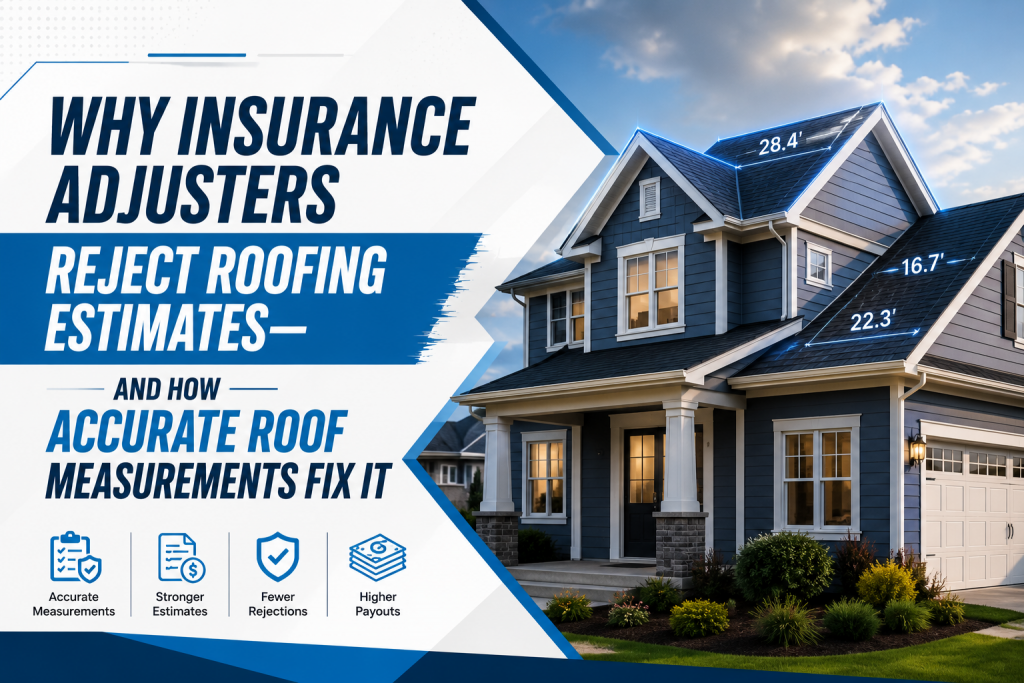
Accurate roof measurements help roofing contractors reduce estimate rejections, improve claim approvals, and increase insurance payouts.